
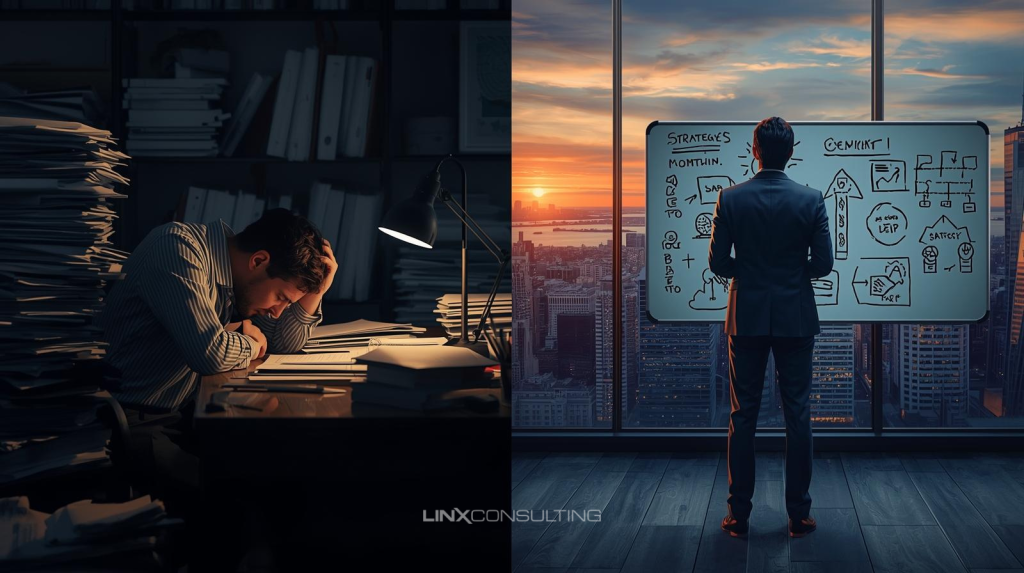
The Busy Bee Illusion
Picture a bee buzzing around a garden. It’s moving nonstop, darting from flower to flower, wings flapping like crazy. From a distance, you think, Wow, that bee is productive! But here’s the twist: what if that bee never actually collects pollen? What if all that buzzing is just… buzzing?
That’s what happens to many small business owners. They’re busy—crazy busy. They’re answering emails, posting on social media, tweaking their website, running networking events, and juggling a dozen apps. They feel productive because they’re in motion.
But here’s the truth: motion isn’t progress. Activity isn’t impact.
The Trap of “Doing”
Small business owners often fall into the trap of equating busyness with success.
- “I worked 12 hours today!”
- “I knocked out 50 tasks!”
- “I’m hustling harder than ever!”
And yet… the business isn’t growing. Revenue is flat. Customers aren’t multiplying. The dream feels stuck.
Why? Because most of those tasks—while they feel good—don’t actually move the needle. They’re active without impact.
Analogy #1: The Treadmill vs. The Trail
Imagine running on a treadmill for an hour. You sweat. You burn calories. You feel exhausted. But when you step off, you’re in the same spot. Now imagine hiking for an hour along the trail. You sweat. You burn calories. But you also move forward—you end up somewhere new.
Many business owners live on the treadmill. They’re working hard, but they’re not going anywhere. Impact means getting off the treadmill and onto the trail.
Why This Happens
- Comfort in the Familiar
Owners gravitate toward tasks they know—checking email, tweaking logos, posting on Instagram—because they feel safe and in control. - The Illusion of Progress
Crossing things off a to-do list feels amazing. But if those things don’t drive revenue, improve operations, or strengthen strategy, they’re just noise. - Avoiding the Hard Stuff
Impactful work is often uncomfortable:
- Making tough hiring decisions
- Building systems
- Reviewing financials
- Selling at a higher level
So, owners stay busy with easy wins instead.
The Cost of Activity Without Impact
- Burnout without Breakthrough – You’re exhausted, but the business isn’t better.
- Missed Opportunities – While you’re tweaking fonts, competitors are closing deals.
- Stalled Growth – Activity feels like progress, but it’s just motion without momentum.
What Counts as Impact?
Impactful activities are the ones that:
✔ Drive revenue
✔ Improve efficiency
✔ Strengthen customer relationships
✔ Build scalable systems
✔ Position the business for long-term success
Examples:
- Closing a high-value client
- Documenting a repeatable process
- Training your team to take ownership
- Reviewing financial metrics and making strategic adjustments
Analogy #2: Rearranging Deck Chairs on the Titanic
You can spend hours making the chairs look perfect. But if the ship is sinking, all that effort is meaningless.
In business, rearranging deck chairs looks like:
- Spending hours on a new logo while ignoring cash flow
- Perfecting Instagram captions while neglecting sales calls
- Obsessing over office décor while your team lacks clear roles
Impact means fixing the leak, not fluffing the chairs.
How to Shift from Activity to Impact
Here’s how small business owners can break free from the busyness trap:
- Audit Your Time
Track your tasks for a week. Then ask:
- Which of these activities directly grew revenue or improved operations?
- Which was just “feel-good” busy work?
- Define Your Impact Zones
Identify 3–5 areas that truly move the needle:
- Sales & Marketing
- Operations & Systems
- Financial Management
- Team Development
- Apply the 80/20 Rule
80% of your results come from 20% of your actions. Find that 20% and double down.
- Schedule Impact First
Block time for high-impact work before anything else. Emails and admin can wait.
- Delegate the Noise
If it doesn’t require your expertise, delegate it. Free yourself to do the work you can.
Making It Real for Small Business Owners
Imagine you own a landscaping company.
- You spend hours designing a new logo, posting on Facebook, and organizing your truck inventory.
- Meanwhile, you haven’t followed up with last week’s lead. You haven’t reviewed your pricing strategy. You haven’t trained your crew to upsell services.
Those first tasks? Activity.
Those second tasks? Impact.
Which ones will actually grow your business?
The Bottom Line
Activity feels good. The impact feels hard. But the effect is what builds businesses.
The question isn’t: How much did I do today?
The question is: Did I do the things that matter?